





Organizational silos & superheroing
In last month’s report card I mentioned that we got a C grade in organization for the project, and would follow up with a more in-depth discussion. So here we are!Since this section is about our organizational structure, it more than the rest of these posts is co-written by my co-leads Josh Boykin and Mark Carpenter.
To give you an overview, here’s an org chart with our current job roles and the lines of regular communication:
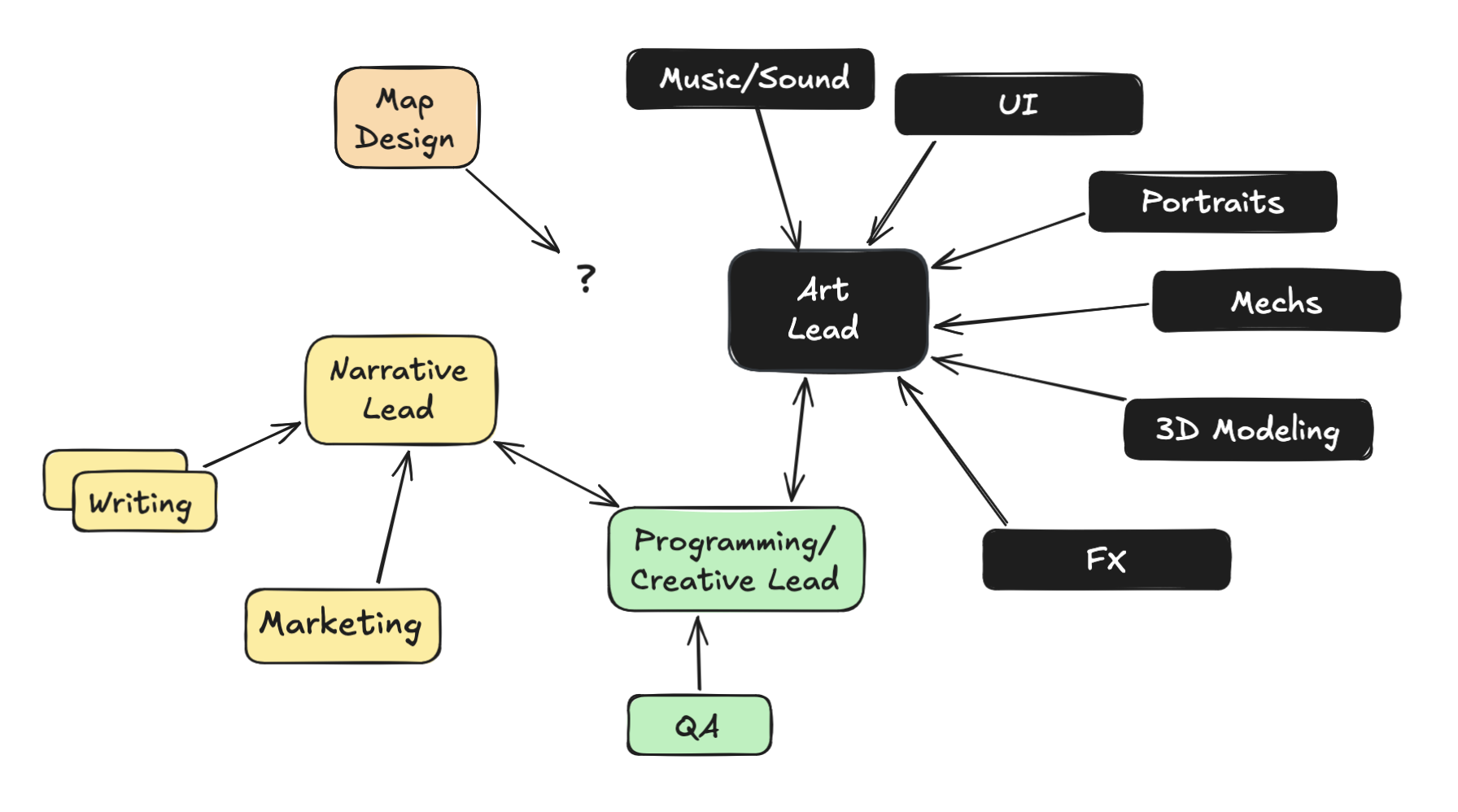
Three salient points here:
- As a near-fully remote team, communication between members doesn’t come for free & had to be explicitly planned. Mark, as Art Lead, ended up acting as an “axle” whose near entire job, at times, became having individual calls to make sure everyone was moving in the right direction and speeds.
- Josh started working with us at the end of year 2 as a writing editor, but as it dawned on us how much we needed help on the non-Lancer-mechanics side of the game, he shifted to taking on a full Narrative Lead role. However, we never took the time to hash out the clear responsibilities of that role, a pipeline for how exactly to add narrative to the game, nor what resources were required for doing the work.
- I have solid personal relationships with both Mark and Josh. Mark and I were housemates through Covid so have battle-weathered communication & trust from the quarantine years. Josh and I are now housemates in Portland so get a lot of in-person time. However, neither of them had ever met IRL pre-Lancer Tactics so didn’t have existing lines of communication they could use to communicate, and as an organization we didn’t invest in establishing one.
As part of the Kickstarter wrap-up, we flew Mark up to Portland and spent the week talking through the emotions and narratives that had built up. These post-mortem discussions were larger than just these, but I can share the aspects of the talks that are relevant here in terms of our organization. We kept touching on two concepts in particular: siloing and superheroing.
Siloing
I’ve described the experience of making Lancer Tactics as feeling “siloed”, where I talk with the people I’m directly working with but only rarely interact with people more than one step away. As Programming/Creative Lead, I’d get looped in whenever there were bugs/features/designs that required code changes but there are still some contractors I’ve never spoken to. I think that’s natural as teams get larger, but when we’re still as small as we are the only reason we’re not interconnected is because we didn’t invest in doing so.
On the other hand, this siloing was somewhat necessary for budgetary reasons. Even with the Kickstarter, we were never close to being able to hire full-time game artists, so contractors were the only way to get the breadth of work we needed done. A natural consequence of working with someone who’s only available for a short time, or a few hours each week over years, was that they never have a chance to pick up the full context of the game. Mark was left filling those context gaps for everyone, and that took up a lot of time.
For tasks that required cross-discipline collaboration (specifically, implementing the campaign modules) we especially didn’t have a pipeline with clear responsibilities & appropriate resources. Writing, map designs, and implementation notes were scattered across half a dozen different google docs in various directories with no clear way to tell what was the most up-to-date versions — when “USE THIS ONE” starts showing up in your document titles, you know something has gone wrong.
A particularly rough point on this siloing front was Josh’s transition from editing-contractor to Narrative-Lead-core-team-member. Mark and I worked well in the siloed structure, but it left Josh feeling on the outside when trying to pick up the narrative without much context for prior decisions or others to directly work with. We ended up with a lot of crossed wires and unspoken expectations, and those impacts rippled through the project in a number of ways.
How we’re improving:
It’s not actually clear to us what the ideal alternative to contractor siloing is, given our constraints. A few possibilities:
- Possibly some way of more efficiently bringing & keeping everyone up to speed?
- Hiring fewer people with more general skillsets for greater numbers of hours?
- It would also be helpful to invest more time in making sure everyone can validate/implement their pieces in the game itself, which would allow Mark to spend more time to do vision-work and think at a higher-level instead of implementation details and making manual formatting fixes.
Additionally, we’re making some changes to how the core team operates:
- Plan to fly Mark up from SF to PDX at least once a quarter so the core team can work in the same physical space. Having him visit for the half-week for the Kickstarter wrapup has gotten a lot of things moving that would have stagnated if we left it digital.
- We’ve designed an interdisciplinary pipeline for making modules with clear steps, deliverables, and timelines. I’m looking at processes like the one Mark Rosewater has described for Magic: the Gathering.
- We’ve made some slight but structural tweaks: Josh now runs our meetings to put him in a more active administrative role, and we have checkpoints at the beginning and end of each meeting to talk about how we’re feeling as people in addition to how we’re feeling about the work.
- The studio is currently operating under Wickworks, a single-owner LLC that I launched the Kickstarter with because I had it on-hand and needed to move fast. We have a separate operating agreement for the project that’s more equitable, but legally I still own the business. We’re looking into transforming it into a legal co-op under a new studio name (which won’t include my deadname lol). We’re moving a bit slow on it because it’s not urgent, but the hope is that will structurally reflect the values we hold. And also because I want to join a game worker union but currently can’t because I’m an biz owner. :(
We’ve also discussed find an experienced studio consultant to be able to come in and make recommendations. So much of what we’re doing is improvised; we collectively have very little mainstream game dev experience and would likely benefit from some guidance.
Superheroing & Crunch
Many years ago, my father once said that he attended a performance review where someone on the team was hailed as a “superhero” for their work. He was the only one in the room to be taken aback by this; his perspective was that, for a company, needing to have superheroes was a failure. It’s one of the few pieces of advice that he’s given me that I think has really panned out (compared to misses like “to smooth things over, always apologize, even if it’s not your fault”). With this framing, there was a lot of superheroing required to get us to where we are.
For myself, I really am at my happiest when I’m working on a project (“I’m not burning out!”, I oft proclaim, undercut by my wrist braces), but it’s easy for big’uns like LT to consume my life. I often feel the full weight of making the completion line go up, and have adopted adaptive habits that genuinely allow me to work hard without hurting myself emotionally & physically. However, I’ve also been recently describing myself to friends as “a hollowed-out implement of a person, honed to output Lancer Tactics the Video Game.” That’s maybe not great!!
Mark’s version of superheroing was spending a lot of his time filling the context gaps for contractors e.g. manually adjusting palettes so they could be recolored by the shader as we changed the requirements, because doing it himself was faster than communication and training. As described above, this might have been necessary+true given our structure, but ideally we’d find a setup where it didn’t have to be as much.
Josh’s superheroing has come in filling gaps in the project around marketing and business development (connecting with other developers, making connections at conventions, etc). He’s been working in games for over a decade and has been able to make a lot of great connections for Lancer Tactics, plus help organize some of the game’s larger strategy beyond the Kickstarter. But trying to carry those things alongside the challenges with figuring out Lancer Tactics’ narrative side has been overwhelming for him at times, especially when combined with some family emergencies and working other jobs.
How we’re improving:
- We generally saw success when we found ways to pry Olive’s fingers off of jobs — bringing Marko on to process reports & help reproduce bugs has worked fantastically and freed her up to focus more on fixing confirmed bugs and adding content+features. We’ll try to keep finding more places where we can do that.
- Ideally there would be more core team processes as a whole: clearer communication and support for all team members, as well as structured social interactions and process-scaffolding to keep the team cared for as well as the project.
We don’t have a solution to Crunch in Video Games (TM). Games take an absurd amount of effort to make & the economic constraints are a pressure cooker. The angle that I think we have to improve matters for ourselves is to try and be less alone about the work; better integration and ability to ask each other for help and organizational structures (like the pipeline for campaigns I mentioned in the previous section).
With all that said, I’m so proud of and thankful to everyone who contributed to this project. Despite not always being set up for success, through talent and grace and toil we have ended up making a fun game & faithful adaptation of the Lancer TTRPG. Making organizational mistakes is very common for new teams & especially in the wake of an unexpectedly successful Kickstarter. You just don’t know what you need until you get there.
“If you want to go fast, go alone. If you want to go far, go together.”
<== // ==>
“Slow is smooth, smooth is fast.”